


Are you perplexed by all of the Bible translations?
The Bible has been translated more than 100 times into English. In the Afrikaans language, it has been translated 12 times, from 1933 to 2020. Die Bybel in Afrikaans. In order to reach your truth, peace, or God’s real message for mankind, what translation or paraphrase will you use? In other translations, just one translator assumes a role that should be shared among competent biblical translators from diverse denominations. Some merely alter the original texts by inserting new ideas or omitting entire chapters from the Bible.
The Bible has been translated more than 100 times into English. In the Afrikaans language, it has been translated 12 times, from 1933 to 2020. Die Bybel in Afrikaans. In order to reach your truth, peace, or God’s real message for mankind, what translation or paraphrase will you use? In other translations, just one translator assumes a role that should be shared among competent biblical translators from diverse denominations. Some merely alter the original texts by inserting new ideas or omitting entire chapters from the Bible.
An example of two different translations of Our Lord’s Prayer in Matthew 6:9–13.
An example of two different translations of Our Lord’s Prayer in Matthew 6:9–13. In almost every act of Christian worship, Christian children memorise these words: “Our Father, who is in heaven…” Traditionalists may take offence at Pope Francis’s approval of a change to the wording of the Lord’s Prayer. This completely undermines the teachings of the Bible. Paul cautions us to exercise caution when dealing with God’s Word. We are not there to follow the crowd (2 Cor. 2:17), for we are not as many, which corrupt the word of God; but as of sincerity, as of God, in the sight of God speak we in Christ.
“But we have renounced the hidden things of dishonesty, not walking in craftiness nor handling the word of God deceitfully, but by manifestation of the truth, commending ourselves to every man’s conscience in the sight of God.” 2 Corinthians 4:2

Dive into a compelling exploration of one of Christianity’s most foundational texts. Get your copy of Fallen Faith: Revisiting the impact of the Apostles’ Creed on Modern Society on Google Books and challenge what you think you know.
Since every Bible translation includes some human error, I find that studying and preparing sermons for certain portions of scripture necessitates the use of multiple translations simply to clarify certain portions of scripture. Solomon said in Ecclesiastes 12:12, “Of making many books, there is no end.” Translations of the Bible can be taken as a case study of Solomon’s statement.
Using word-for-word translation puts more responsibility on the reader to understand the author’s intended meaning than using thought-for-thought translation. When the translation is word-for-word, the reader must determine the author’s intended meaning by studying the original text.
Thought-for-thought: by taking into account the intended meaning of the author at the time of the original writing, the thought-for-thought is able to convey the author’s intention to the original audience. Because they trust the translators’ interpretation, readers place a great deal of trust in their work. The wording is good for making Scripture more understandable, but the doctrinal reliability isn’t great. The original writers’ intent is sometimes interpreted in these versions.
Paraphrase: One author produces a lot of paraphrases in which they “translate” the Bible using only their own words, occasionally without any source language. Listed below are some translations of the Bible that you should avoid for any real and faithful Bible study. A word of caution about paraphrased Bibles: they should never be considered the source of sound Biblical doctrine. At times, the writers’ personal religious views and ideologies colour their interpretations of the texts.
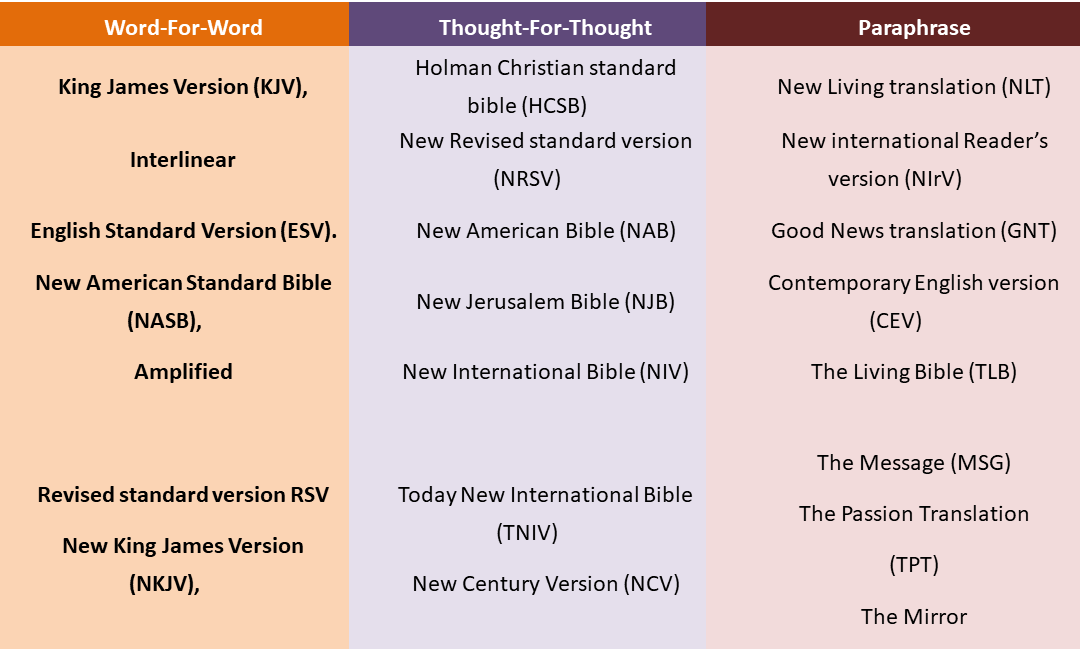
In summary:
The Bible has been translated over 100 times into English and 12 times into Afrikaans. Selecting a translation is crucial for understanding God’s message, as some translations may alter original texts or introduce new ideas. Traditionalists may be upset by changes endorsed by figures like Pope Francis, which can undermine biblical teachings. Caution is advised when engaging with scripture, as every translation carries potential human error.
Studying multiple translations can help clarify scripture, with three main types:
- Word-for-word (formal equivalence): Requires readers to interpret the author’s intended meaning.
- Thought-for-thought (dynamic equivalence): Focuses on conveying the author’s intention to the original audience but may sacrifice doctrinal reliability.
- Paraphrases: Often subjective and should not be relied upon for sound doctrine.
Careful study of original manuscripts is essential, as paraphrased versions may reflect the author’s personal biases.
